Pick up two bottles of liquid nutrient and the first thing most growers compare is the NPK ratio. Higher numbers appear to signal stronger, more effective nutrition—logic that holds until you understand what those numbers actually measure, and everything they don't.
NPK represents nitrogen (N), phosphorus (P), and potassium (K)—three essential nutrients for plant growth. The ratio appears on every fertiliser label and has long been treated as the definitive quality benchmark. For growers seeking genuinely informed decisions, those three numbers are merely the foundation.
What NPK Actually Tells You
Each nutrient serves a distinct function. Nitrogen drives leaf and stem development, powering lush, green foliage. Phosphorus supports root architecture and flowering. Potassium regulates cellular water movement and builds environmental resilience. Every plant requires all three, and their ratio matters: tropical foliage thrives with elevated nitrogen, while flowering orchids benefit from increased phosphorus and potassium.
The NPK ratio provides a useful snapshot of nutritional weighting and enables basic product comparison. The limitation lies not in what NPK reveals, but in what growers assume it represents. Three numbers from twelve essential minerals cannot constitute a complete picture.
"I honestly can't recommend the GT range enough. All my plants are in the best condition they've ever been in—and that's saying a lot because I've been growing plants for over 10 years."
What NPK Doesn't Tell You
The other nine essential minerals
Plants require 12 essential minerals to complete their growth cycle. Calcium constructs cell walls and supports new growth. Magnesium anchors every chlorophyll molecule, making photosynthesis possible. Iron maintains leaf pigmentation. Sulphur, manganese, zinc, copper, boron, and molybdenum each govern enzyme function, growth regulation, and metabolic processes that nitrogen, phosphorus, or potassium cannot replace.
A fertiliser displaying impressive NPK numbers, but lacking calcium, magnesium, or trace elements delivers incomplete nutrition. Plant growth is constrained by its most limited nutrient—a principle known as Liebig's Law of the Minimum1. Abundant nitrogen cannot compensate for insufficient iron to maintain chlorophyll, or inadequate calcium to build cellular structure. Addressing three nutrients while neglecting nine others doesn't remove the limitation—it just moves the bottleneck.
Bioavailability: what plants can absorb
High NPK numbers do not guarantee nutrient accessibility. Mineral form profoundly influences uptake. Certain forms of iron, for instance, remain poorly absorbed unless chelated—chemically bound to organic molecules maintaining solubility and availability. Two products with identical NPK ratios can produce very different results depending on ingredient bioavailability.
For liquid nutrients designed to deliver immediately soluble minerals, formulation quality determines everything. How minerals are processed, stabilised, and balanced governs how much of what's in the bottle reaches the plant—a critical distinction that no NPK ratio reveals.
The influence of pH
Well-formulated nutrients become inaccessible when pH drifts outside optimal ranges. When pH drifts too high or too low, certain minerals lock out—they're still present in the water, but roots cannot absorb them. This is one of the most common causes of deficiency symptoms in otherwise adequately fed plants, yet NPK ratios provide no indication of pH considerations.
Quality liquid nutrients are pH buffered during formulation, maintaining stable pH ranges that preserve mineral availability. This represents a significant advantage over products requiring growers to manage pH independently—yet it remains invisible on product labels.
Why This Matters for Liquid Nutrients
NPK ratios were developed for granular and powdered fertilisers, where concentration is relatively fixed, and release occurs gradually as products break down in soil. Liquid nutrients function differently—they deliver minerals in soluble form, ready for immediate uptake. This makes formulation quality, mineral balance, and bioavailability far more influential than raw label percentages.

Comparing liquid nutrients solely by NPK values resembles comparing meals by calorie count alone. Calories may match, but one provides complete nutrition and the other lacks essential vitamins and minerals entirely. The number cannot capture the full nutritional picture.
FAQs
Liquid Nutrients FAQs
What is the difference between nutrients and additives?
What’s the ideal pH for hydroponic nutrient solutions?
Why are macronutrients important in hydroponics?
Why do micronutrients matter in hydroponics?
How do I mix hydroponic nutrients effectively?
Complete Nutrition by Design
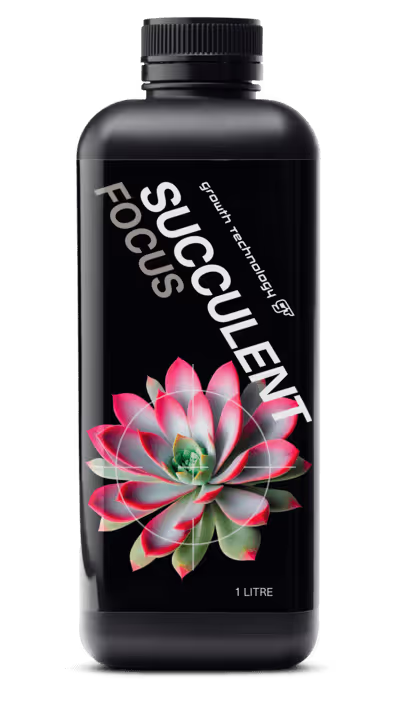
The range of GT Focus products is formulated around this understanding. Rather than pursuing elevated NPK numbers, every GT Focus product delivers all 12 essential minerals in bioavailable forms, with chelated trace elements ensuring reliable uptake. Each formulation is pH buffered for stability, independently laboratory tested for consistency, and free from harmful chlorides, urea, and sodium.
Across 13 plant-specific formulations—from GT Foliage Focus for leafy tropicals to GT Succulent Focus for drought-adapted species to GT Orchid Focus for flowering epiphytes—NPK ratios are calibrated to the species requirements. The ratio represents one element of comprehensive nutritional design. Different plants demand different mineral balances, and the GT Focus range is built around this principle rather than numerical maximisation.
GT Focus Range


Looking Beyond the Label
NPK ratios aren't misleading—they're incomplete. They describe three of 12 essential nutrients, and reveal nothing about formulation, stabilisation or delivery mechanisms. Understanding what you're giving your plants, and looking beyond those three numbers is where the real knowledge begins.
Optimal nutrition isn't determined by the highest numbers on the label. It's defined by delivering everything your plant needs, in forms it can absorb, every time you water.
———
- Liebig's Law of the Minimum, first proposed by Carl Sprengel (1828) and later popularised by Justus von Liebig (1840), states that plant growth is limited not by the total amount of resources available, but by the scarcest essential resource. In practical terms, even abundant macronutrients cannot compensate for a deficiency in any single essential mineral.