A philodendron putting out leaf after glossy leaf in a living room. An anthurium holding colour indoors for months. Alocasias standing tall metres from the nearest window. These results are entirely achievable, and the growers achieving them are not working with better luck or better plants. They have simply worked out what changes when a plant moves inside — and adjusted for it.
Most of us learn to grow outdoors first. A balcony pot, a garden bed, a few successes, and the confidence to bring plants in. Indoors, that confidence often meets a plant that sulks, yellows and drops leaves within a season. The plant has not changed. Its world has.
What Changes When a Plant Comes Inside
Outdoors, a plant draws on resources it never has to be given. Rain arrives with dissolved minerals and washes accumulated salts down through the profile. Soil life cycles organic matter into available nutrition. Roots extend beyond the pot into a functionally unlimited volume of substrate. Wind moves air across leaves. Light follows a season.
Indoors, every one of those systems is replaced by a decision the grower makes. That is the shift worth understanding, because it turns indoor growing from guesswork into a set of manageable variables.
Five Conditions to Bring Back Under Control
1. Soil volume is finite — and so is what it holds
A pot holds a fixed quantity of substrate, and that substrate holds a fixed quantity of available minerals. Outdoors, roots keep searching. Indoors, they run out. Repotting into progressively larger vessels buys time, but it is not a strategy — eventually the pot is as large as the room allows and the plant is still hungry.
The practical consequence: a plant that grew beautifully for four months and then stalled is usually not sick. It has consumed what the mix contained.
2. Water has nowhere to go
Overwatering is the most common indoor problem, and the mechanism is drainage rather than volume. In the ground, excess water moves away. In a pot on a saucer, it sits in the lower third of the substrate, displaces air from the root zone and creates the anaerobic conditions that cause root decline.
Water thoroughly, allow the excess to drain fully away, and let the mix approach dryness before watering again. The rhythm matters more than the frequency.
3. The room sets the conditions, not the season
Evaporation rates, temperature and humidity vary from room to room in the same house — and change again when heating or air conditioning runs. A plant thriving in a bathroom may struggle in a bedroom three metres away. Reading the room, rather than following a generic care label, is what allows placement decisions to be made with confidence.
4. Light indoors is rarely what it appears
Human eyes adapt to low light; plants do not. Interior spaces that feel bright often sit well below the intensity a tropical foliage plant needs, while artificial light running for extended hours can extend the day beyond anything a plant experiences in nature. Moving a plant closer to a window, or into filtered rather than deep shade, frequently resolves what looked like a nutrition problem.
5. Nutrition has to be delivered, not assumed
This is the condition most growers address last, and it is the one that limits results most.
Solid and granular products are difficult to work with in a pot. Distribution is uneven, release is unpredictable, and there is often simply no room to incorporate them into the substrate without disturbing established roots. The alternative is liquid nutrition: minerals already dissolved, delivered evenly through the root zone with the water the plant was going to receive anyway. Feeding and watering become one action.
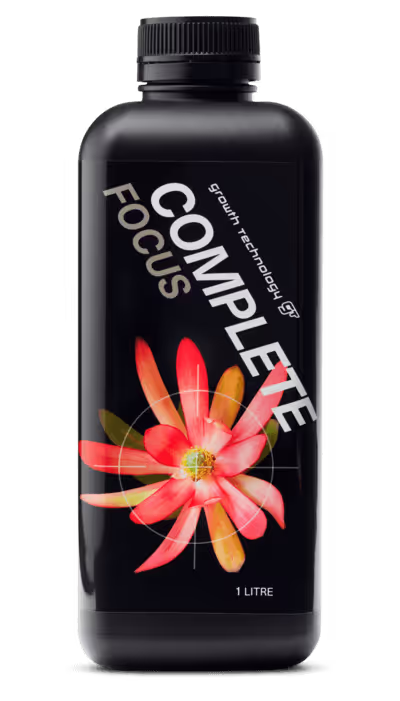
For this to work, the formulation matters. Plants require twelve essential minerals, and a deficiency in any one of them limits growth regardless of how much of the others are present. A complete liquid formulation supplies all twelve in bioavailable form and in ratios matched to what the plant is doing — in the case of foliage plants, building leaves.
How One Sydney Grower Applies It
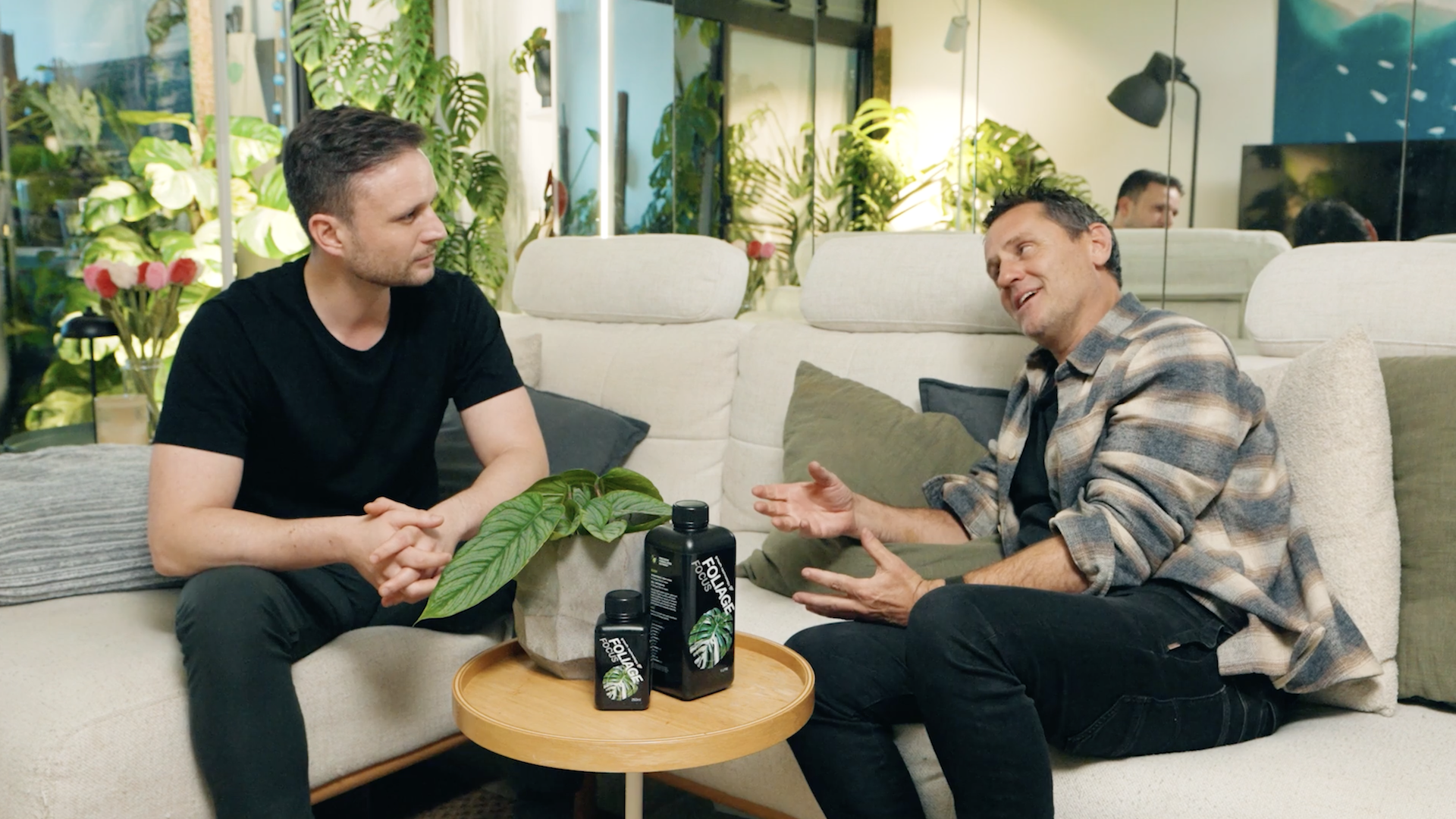
Jan Gettman, known to a large online audience as Sydney Plant Guy, grows philodendrons, anthuriums and alocasias indoors at a standard most growers would associate with a greenhouse. His account of the method is unglamorous, and that is rather the point.
He begins with placement, not product. Conditions establish the ceiling; nutrition determines how close a plant gets to it.
Feeding With the Water
Gettman feeds Foliage Focus at every watering, in organic substrates rather than a hydroponic system — a detail worth noting, because complete liquid nutrition is frequently assumed to be a hydroponics-only approach. It works equally well in traditional potting mixes, where it addresses precisely the depletion problem that pots create.
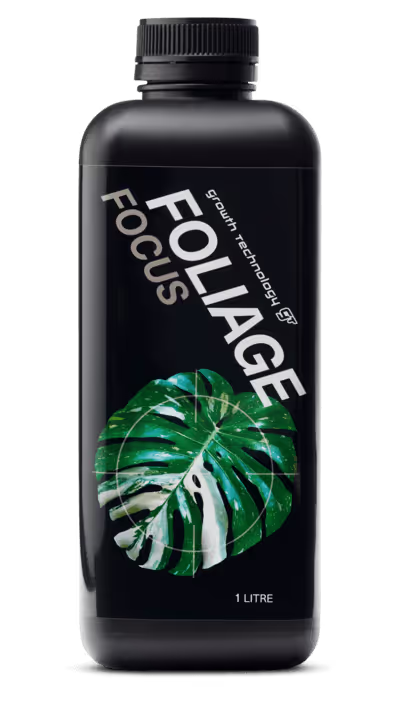
Foliage Focus is formulated to encourage profuse, lush foliage growth, with all twelve essential minerals in ionic form for immediate uptake at the root. It suits non-flowering plants, and particularly the common and rare tropical varieties that fill an indoor collection.
Getting the rate right
- In potting mix: 3–5 ml per litre of water
- In hydroponic and semi-hydroponic systems: 5–7 ml per litre of water
- Maintenance: flush with plain water monthly to prevent mineral salt accumulation
Made in Perth, Western Australia, Foliage Focus is available online and through stockists nationally, plus distributors in New Zealand, Singapore, Thailand, Malaysia, Europe (Croatia and the wider EU) and the United States — with more countries in progress.
The Nutrition Behind These Results
Foliage Focus
Complete Focus
Building a Rhythm You Can Keep
The growers who succeed indoors are rarely the ones doing the most. They are the ones doing the same few things consistently.
- Place first, then feed. Light, temperature, humidity and airflow set the potential. Nutrition realises it.
- Feed with the water. Diluting nutrition into every watering removes the need to remember a separate schedule, and gives roots a steady supply rather than a spike.
- Flush monthly. Plain water through the pot clears accumulated salts and keeps the root zone functioning.
- Watch the newest growth. New leaves emerging smaller, paler or more slowly than the last are the earliest indication that something in the system needs attention.
Indoor growing is not harder than growing outdoors. It simply asks the grower to supply what the sky, the soil and the seasons supply for free — and once that is understood, a room full of thriving plants stops being luck.
———
- Jan Gettman (Sydney Plant Guy), on his indoor growing method, 2026.